
The Pipeline That Thinks: Building an AI-Powered DevSecOps Pipeline on AWS EKS

Most CI/CD pipelines are conveyor belts. Code goes in through one end, and a deployed artifact comes out the other. The pipeline itself has no opinion about what it is shipping, no awareness of what happened after it shipped it and no ability to respond when something goes wrong.
This model is becoming increasingly inadequate.

Companies adopting AIOps can reduce downtime and free operations teams, allowing them to focus on strategic projects. Security is becoming an integrated part of DevOps — the DevSecOps approach means embedding security checks directly into the pipeline. However, most implementations of ‘AI in DevOps’ still treat AI as a tool developers use before the pipeline, not as a participant inside it.
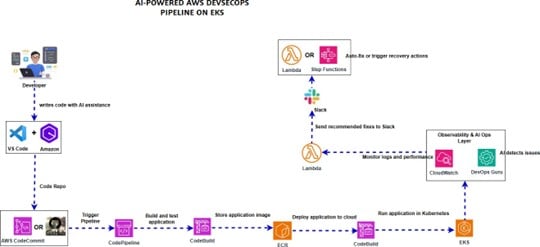
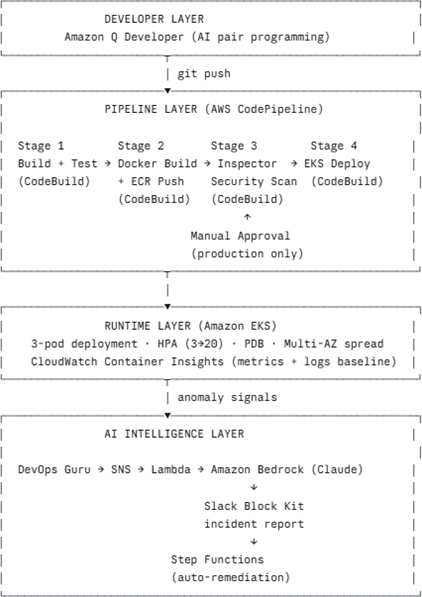
I designed something different: An AWS-native DevSecOps pipeline on Amazon EKS where AI is embedded at every stage, reviewing code as it is committed, scanning images before they deploy, monitoring applications after they go live, synthesizing incident intelligence when anomalies are detected and triggering recovery actions before the first support ticket arrives.
This is the architectural breakdown:
The Problem With Today’s Pipelines
Many teams experimented with DIY automation in 2024–2025 and now face an ‘integration tax’ — dozens of custom scripts, inconsistent standards, unclear ownership and slow onboarding for new developers.
The result is pipelines that are technically sophisticated but operationally brittle. They test well. They deploy reliably. However, they are not intelligent. When a deployment causes a latency regression at 2 a.m., the pipeline that shipped that deployment has nothing to say about it. A human gets paged. A human diagnoses. A human fixes.
Analysts argue there is “no future of IT Operations that does not include AIOps.” The AIOps market is growing rapidly at a roughly 15% CAGR. AIOps tools apply ML to log data and metrics so teams can automatically detect anomalies, predict outages and even recommend fixes.
The architecture I am about to describe operationalizes this, not as a separate AIOps platform layer, but as a native capability of the delivery pipeline itself.
Architecture: The Complete Picture
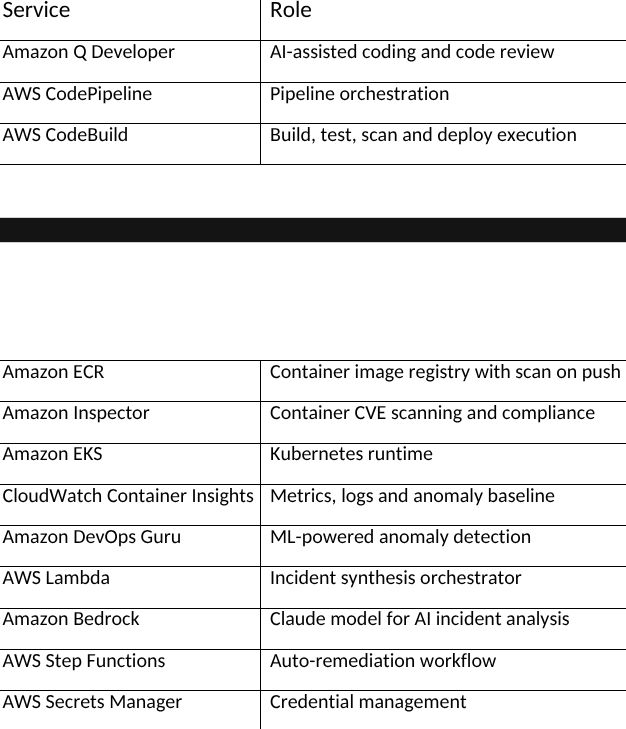
AWS Services Used
The Design Choice That Warrants Explanation
I built this architecture almost entirely on managed AWS services rather than the open-source DevSecOps stack (Trivy, Prometheus, Grafana, ArgoCD). This is a deliberate trade-off.
By 2026, 40% of organizations are projected to adopt DevSecOps practices. Companies are recognizing the importance of integrating security into the CI/CD pipeline rather than treating it as an afterthought. The question is not whether to integrate security; it is which tooling context makes that integration sustainable for your specific organization.
For enterprise environments, regulated finance, health care and insurance, managed services win on dimensions that open-source tools cannot easily address:
- Compliance Certifications: Built into the service (FedRAMP, SOC 2, HIPAA, PCI DSS)
- Vendor SLA: When the managed service has an incident, AWS fixes it
- Reduced Operational Surface: No Prometheus cluster to patch at 11 p.m.
- Software Supply Chain Control: Auditable, known provenance for every component
The trade-offs are real: Higher cost at scale, limited customization and vendor dependency. I will show you a hybrid approach at the end for teams where these trade-offs do not work.
Stage 1: Build and Security-Audit the Code
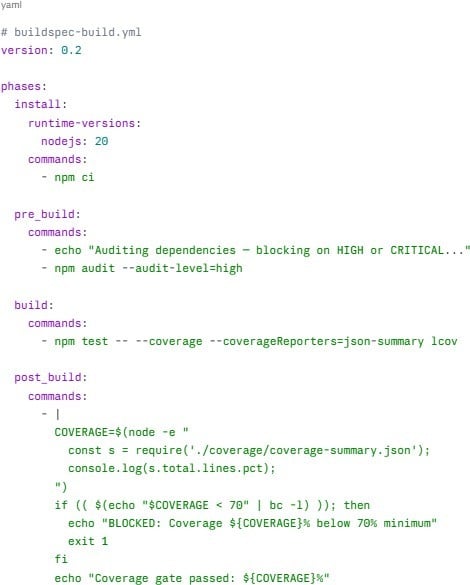
The first CodeBuild stage builds the application, runs tests, enforces coverage thresholds and runs “`npm audit“` to catch known vulnerabilities in dependencies before a single line of code touches a container image.
Why This Matters
Catching dependency vulnerabilities at build time, before any image is built, means the security signal arrives when a developer can act on it, not three stages later after compute resources have already been consumed.
Stage 2: Build a Security-Hardened Container Image
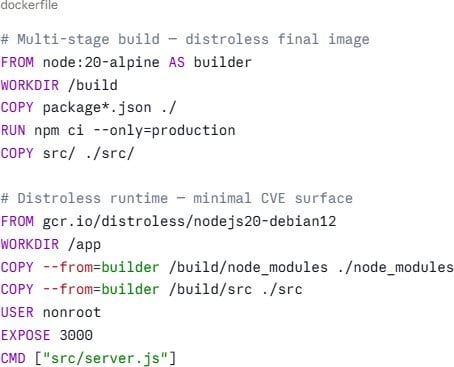
The Dockerfile uses a multi-stage distroless build. The distroless base image contains only the application runtime — no shell, no package manager, no utilities. This directly reduces the CVE surface that Inspector will scan in Stage 3.
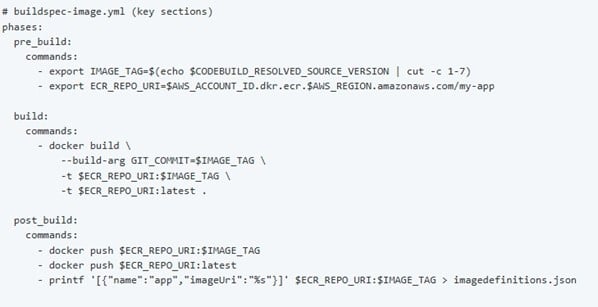
The CodeBuild stage that builds and pushes this image tags it with the git commit SHA, not ‘latest’. Every image in ECR is traceable to the exact commit that produced it.
Stage 3: the Amazon Inspector Security Gate
Amazon Inspector scans the pushed image for CVEs in OS packages and application dependencies. ECR is configured with scanOnPush=true, so Inspector begins scanning the moment the image arrives.
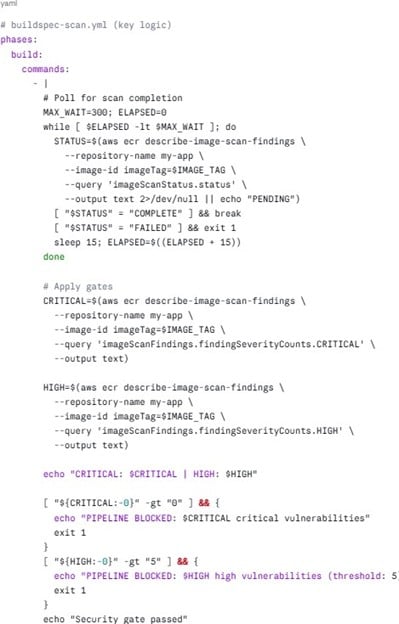
The CodeBuild stage polls for scan completion, retrieves the findings, applies configurable severity thresholds and blocks the pipeline if critical vulnerabilities are found.
The Gate Configuration
Zero tolerance for CRITICAL CVEs. A configurable threshold (default 5) for HIGH CVEs acknowledges that some HIGH findings have no available patch or have acceptable risk profiles, given the application context. Every environment’s threshold should be a documented, reviewed decision, not a default left unchanged.
Stage 4: Deployment to EKS With Health Verification
The Kubernetes manifests enforce security and reliability at the pod level.
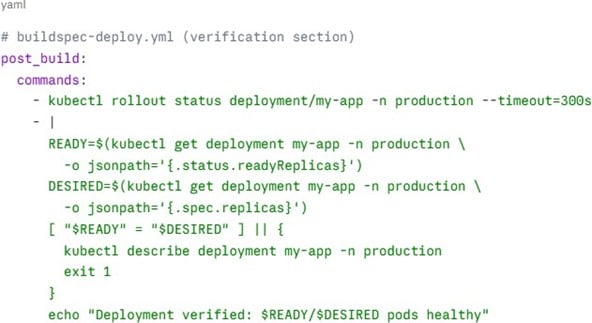
The deployment buildspec waits for the rollout to complete and then verifies that the expected number of pods is healthy before marking the stage as successful. A deployment that rolls out but leaves pods in a crash loop will fail the pipeline and trigger a rollback.
The AI Intelligence Layer: Where This Becomes Different
AIOps platforms analyze vast amounts of operational data to detect anomalies, predict issues and automate responses. Automated remediation: Executing predefined actions to resolve detected problems without human intervention.
Amazon DevOps Guru learns a baseline of normal behavior for your EKS workloads from CloudWatch Container Insights metrics, CPU utilization, memory pressure, pod restart counts and HTTP error rates. When it detects a deviation beyond the learned normal range, it publishes a structured insight to SNS.
The Lambda function receives this notification, enriches it with recent CloudWatch metrics for additional context and calls Claude on Amazon Bedrock to generate a structured incident analysis.
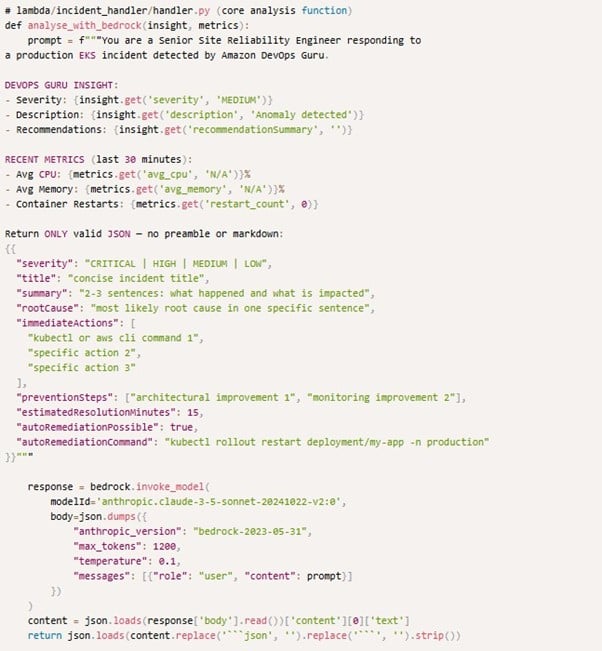
The temperature: 0.1 setting is intentional. Incident response analysis requires deterministic, consistent output, not creative variation. Lower temperature produces a more reliable JSON structure and more conservative root-cause attribution
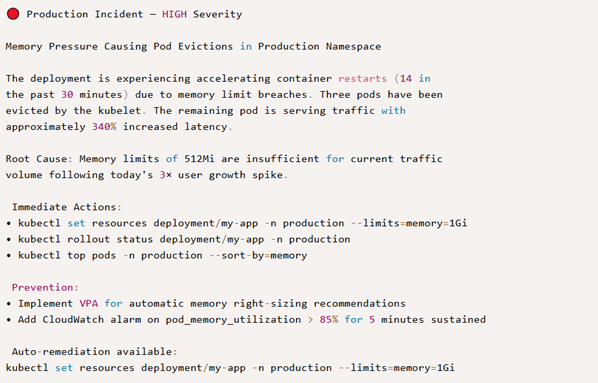
The Slack report is generated using Block Kit, producing a message that is actionable rather than merely informative.
Step Functions: Auto-Remediation With Appropriate Governance
When the AI analysis indicates that auto-remediation is possible, the Lambda triggers a Step Functions state machine. The state machine applies different governance rules based on severity:

This is the key governance design: Auto-remediation is not binary. The system’s confidence in executing without human confirmation scales inversely with the potential blast radius of the action.
A pod restart (kubectl rollout restart) with limited blast radius executes automatically. A database failover or traffic rerouting decision, actions with broader production impact, require a human approval step before execution, regardless of what the AI recommends.
Enabling DevOps Guru on EKS
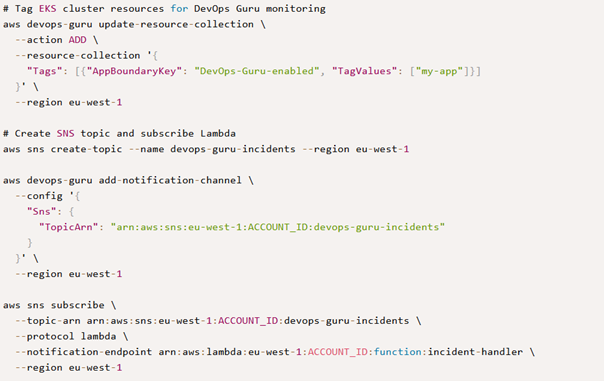
DevOps Guru requires 2–3 weeks to build a reliable anomaly baseline from Container Insights metrics. Plan your production enablement accordingly, enable it during a stable period, not immediately before a major release.
The Hybrid Alternative
For teams where the managed-services cost model does not work, here is the equivalent architecture using open-source tooling where appropriate:
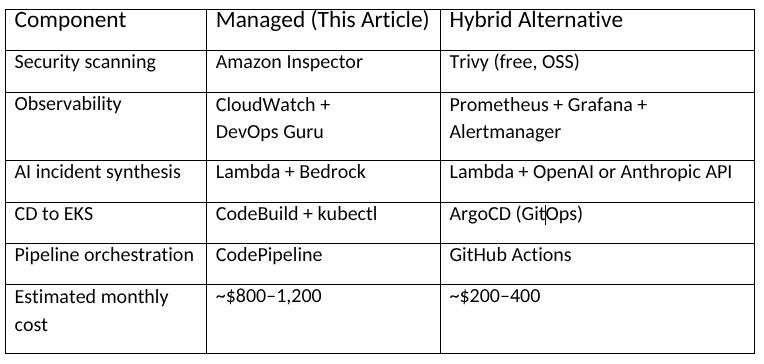
The one component I would retain in both architectures: The Lambda + Bedrock AI synthesis layer. This is the highest-value, lowest-cost element of the entire stack. The $15–30/month in Bedrock inference costs for incident analysis is the most defensible line item in the architecture budget.
What This Changes About DevOps Engineering
AI-ready IDPs aim to reduce cognitive load on developers and accelerate delivery without compromising quality or governance. They can offer context-aware recommendations, enforce policy as code, generate environment previews and integrate AI assistants directly into workflows.
The pipeline described in this article is one implementation of that principle. But the more important shift is conceptual.
When the delivery system can detect its own failures, synthesize diagnostic intelligence and participate in its own recovery, the DevOps engineer’s role changes. Less time as first responder. More time as system designer. Less incident response at 2 a.m. More incident prevention architecture during business hours.
By 2026, 40% of DevOps teams are projected to incorporate AIOps as a standard component, significantly reducing the time spent on routine operations tasks and improving service quality.
The pipeline that simply deploys is already becoming the baseline expectation, not a competitive advantage. The organizations building pipelines that think, review, secure, monitor and recover, are defining what the next baseline looks like.
