DevZero Launches Automation Platform to Dynamically Rightsize Kubernetes Clusters

DevZero today launched an autonomous infrastructure optimization platform for Kubernetes clusters based on a profiler that continuously monitors clusters, nodes, and individual workloads to build statistical models of demand for resources.
Company CEO Debo Ray said the DevZero platform then uses those statistical models to apply context-aware scheduling and autoscaling to rightsize workloads in real time by dynamically adjusting CPU, memory, and graphics processing unit (GPU) provisioning across more than 3,000 instance types, 69,000 price points, 23 types of GPUs and 80 cloud computing regions.

Additionally, DevZero has developed a checkpoint-restore capability that enables instant live migration without restarts to eliminate the need to have IT infrastructure resources standing by just in case additional resources are needed.
All told, the DevZero platform can reduce the total cost of deploying workloads on Kubernetes clusters by as much as 30% to 60%, said Ray. Optimizing consumption of IT infrastructure resources is now more crucial than ever as more artificial intelligence (AI) workloads that are dependent on expensive GPU resources are now being deployed, he added.
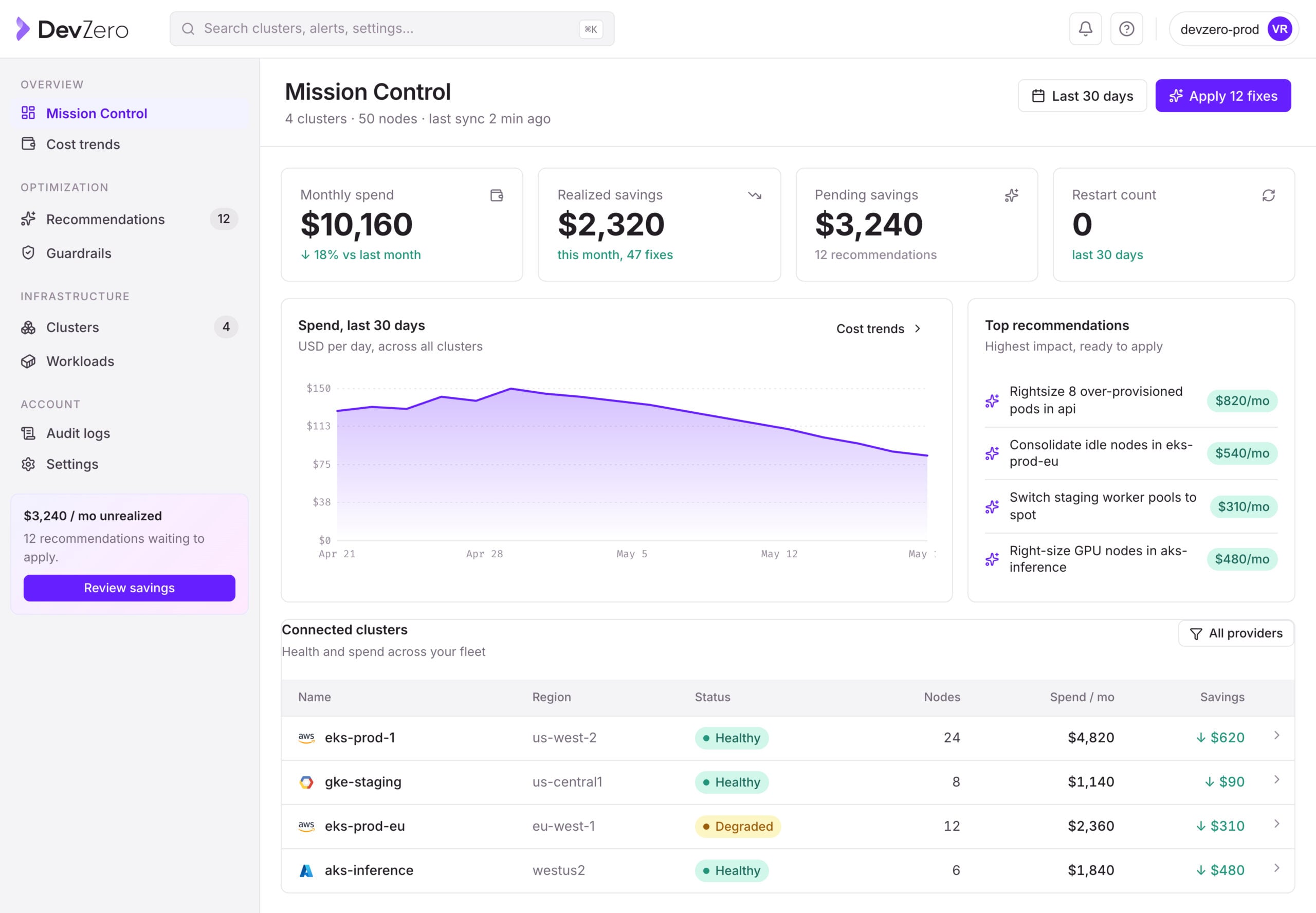
Prior to adopting the DevZero platform, IT teams were on average overspending on compute by 53%, said Ray. Early adopters of the DevZero platform include DataBahn, Dentira, Starburst, OpenObserve, and Outerbounds.
It’s not clear to what degree IT teams are focused on reducing IT infrastructure costs, but one of the original promises of Kubernetes is that IT teams would be able to dynamically scale resources up and down as needed. In reality, the inherent complexity of Kubernetes has made it difficult for most IT teams to achieve that goal.
In the meantime, application developers continue to overprovision Kubernetes clusters on the assumption that making as much compute and memory available as possible will minimize any downtime that might otherwise occur. Most application developers have little to no visibility into actual costs so they tend to assume that infrastructure costs in the era of the cloud are nominal. As a result, utilization rates even for Kubernetes clusters are often measured in single digits.
It’s not clear to what degree the rise of AI workloads might lead to some fundamental changes. GPUs remain scarce so there is more focus on improving utilization rates. The challenge is that not nearly enough IT teams have the tools and expertise required to achieve that goal.
Hopefully, there will come a day when optimization of IT infrastructure resources is routinely automated. Unfortunately, in addition to the technical challenges that IT teams currently encounter, there is a significant amount of cultural inertia that needs to be overcome as well. Far too many application developers simply don’t design their applications with regard for what it might cost to run them. Many of those issues are then later addressed by software engineers that are trying to do the best they can to optimize an application that might be fundamentally flawed.
In the meantime, however, short of refactoring an application, advances in automation should hopefully make it a lot simpler for mere mortal IT professionals to maximize consumption of complex IT infrastructure environments.