
Red Hat OpenShift as a Hybrid Engine for GitOps Driven Application Modernization

In many organizations, the decision to move from legacy deployment practices to a GitOps operating model has already been made. Strategy decks have been approved, target architectures have been sketched and pilot projects are underway. What often slows progress is not the ‘why’ of GitOps but the ‘where’: On which platform do you consistently implement those practices across on-prem, private cloud and public cloud?
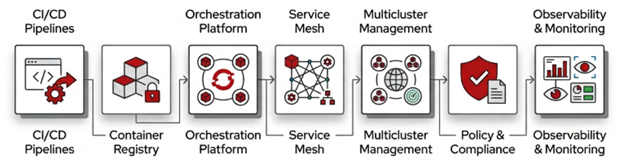

This article picks up from where a typical ‘from legacy to GitOps’ roadmap leaves off and focuses on one concrete answer to that ‘where’ question: Using Red Hat OpenShift as the hybrid execution engine for GitOps-driven application modernization. The goal is to give practitioners practical patterns they can apply, regardless of which specific tools they use on the platform.
From GitOps Roadmap to Platform Reality
A GitOps roadmap usually outlines phases such as:
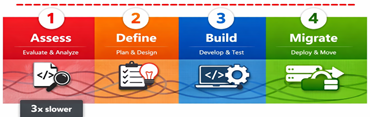
- Assess Legacy Applications and Environments
- Define a Git-Centric Operating Model
- Build an Automation Backbone
- Migrate Workloads Incrementally
In presentations, this is straightforward. In reality, the complexity of hybrid infrastructure turns each phase into a tangle of exceptions. Teams end up with multiple clusters, inconsistent deployment mechanisms and different security models, depending on where an application runs.
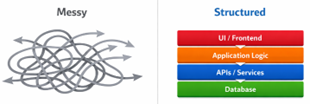
OpenShift’s value in this context is not just that it is ‘a Kubernetes distribution’, but that it can provide a relatively uniform substrate across data centers and clouds. When you can treat clusters in different locations as variations of the same platform, it becomes much easier to implement one GitOps model instead of three or four.
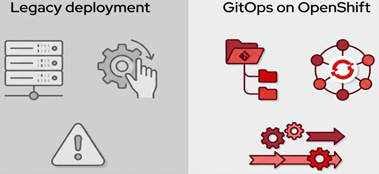
Designing a GitOps Operating Model on OpenShift
A good next step after a high-level roadmap is to define how Git maps to real platform constructs. On OpenShift, that means being explicit about how repositories, branches, namespaces and clusters fit together.
A common pattern looks like this:

- Use separate repositories for platform configuration and application configuration. Platform repositories manage things such as ingress controllers, logging, monitoring and policies. Application repositories manage individual services, their manifests and their environment-specific overlays.
- Treat projects or namespaces as the unit of tenancy for teams or applications. Each environment (development, test, staging and production) has a clearly defined set of namespaces, and those namespaces are described in Git.
- Make promotions between environments Git-driven. Instead of running ad hoc scripts, teams open merge requests that move configuration from one environment path or branch to another. Automated reconciler components then apply the changes to the appropriate OpenShift clusters.
- Encode separation of duties in Git. Platform teams own platform repositories, application teams own their service repositories and approvals encode the control points your organization needs.
This model keeps responsibilities clear while giving everyone the same mental model: To change the platform or an application, change Git.
Building the Automation Backbone
Once the operating model is sketched, practitioners need an automation backbone that connects Git to running systems. On OpenShift-based estates, that backbone generally has three major parts: Infrastructure provisioning, continuous integration and GitOps controllers for reconciliation.
A pragmatic approach might be:
- Use infrastructure-as-code tools to provision OpenShift clusters and supporting services in each environment. Networking, identity and storage are defined as code and reapplied as needed.
- Run one or more GitOps controllers (for example, Argo CD-style tools) that continuously reconcile the desired state in Git with the actual state of OpenShift clusters. Controllers responsible for platform configuration and application configuration are scoped separately.
- Keep continuous integration focused on building and testing artifacts. Pipelines produce container images, run tests, scan for vulnerabilities and once validated, update configuration in Git (for example, by bumping image tags). The actual deployment is left to the GitOps controllers.
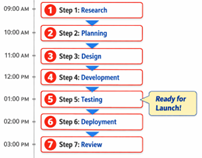
The advantage of this separation is that failure modes are clearer. If something breaks, you know whether to look at the build pipeline, the Git history or the reconciliation layer. That makes life easier for on-call engineers.
Operating in Hybrid and Multi-Cluster Environments
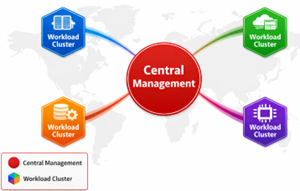
Most modernization efforts are hybrid by necessity. Some workloads remain in on-prem data centers, others move to cloud-hosted OpenShift clusters and still others run on managed Kubernetes offerings. Without a unifying model, each environment tends to evolve its own way of doing things.
A GitOps-on-OpenShift approach can reduce that divergence:
- Central management clusters can host the GitOps controllers that synchronize configuration to multiple ‘workload’ clusters in different locations.
- Platform configuration things such as ingress, observability and policy are defined once and selectively applied to clusters, with overrides for genuine differences.
- Application teams see a consistent workflow: They change Git, watch the controller roll out updates to the appropriate cluster and rely on the same observability and rollback mechanisms everywhere.
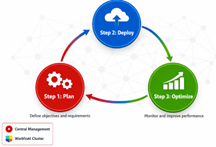
This does not eliminate all differences between environments but narrows them down to what is truly necessary (for example, region-specific endpoints or compliance-driven network rules) instead of accidental variations.
Security, Compliance and Policy as Code
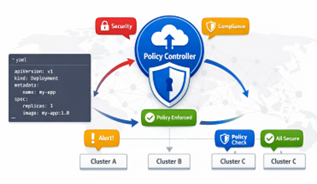
As teams apply GitOps to more critical systems, security and compliance become central concerns. Hybrid environments compound this because each location might start with different defaults and manual exceptions.
On a GitOps-enabled OpenShift estate, you can address this by treating policies as just another configuration category:
- Admission-control rules, network policies and role-based access control are defined as code and applied via the same reconciliation mechanism as other resources.
- Security baselines are captured in platform configuration repositories and automatically enforced across clusters, rather than relying on manual checklists.
- Auditability improves because every policy change has a corresponding Git change, review and commit history. Combined with platform logging, this simplifies investigations and governance reviews.
For practitioners, this means security posture is no longer an opaque set of one-off changes made months ago. It becomes visible, reviewable and testable, like the rest of the system.
Migration Patterns That Work in Practice
Finally, GitOps-driven modernization on OpenShift needs migration patterns that engineers can execute without stalling or burning out. Three patterns show up frequently:
- New Services First: Greenfield workloads are deployed on OpenShift under GitOps control from day one. This gives teams a low-risk proving ground and builds internal experience.
- Strangler Patterns Around Legacy Systems: New components deployed on OpenShift manage traffic for specific capabilities while the legacy system continues to serve the rest. Over time, more traffic shifts to the modern side.
- Lift-and-Shift Containers With Gradual Refactoring: Existing applications are containerized and deployed to OpenShift with minimal changes, but configuration and deployment are immediately brought under GitOps control. Refactoring happens in iterations, not as a precondition.
Each pattern allows for incremental progress. Teams benefit from more predictable deployments, faster rollbacks and easier environment parity without needing a ‘big bang’ cutover that rarely survives contact with reality.
Bringing it Together
Using Red Hat OpenShift as a hybrid engine for GitOps-driven application modernization is less about a single product choice and more about establishing a consistent, Git-centric way of working across diverse infrastructures. When OpenShift clusters are treated as a common platform and Git as the source of truth, practitioners gain a repeatable path from roadmap to day-to-day operations.
