Rancher Labs Simplifies Kubernetes Lifecycle Management

Rancher Labs this week released an update to its distribution of Kubernetes that makes it easier to upgrade without any downtime in addition to making it easier to remotely access.
Company CEO Sheng Liang says that as organizations increasingly operationalize Kubernetes there is now a lot more focus on lifecycle management and scalability.

Version 2.4 of Rancher provides access to a set of tools that makes it easier for IT teams to manage a fleet of Kubernetes clusters event when network connectivity is limited, says Liang. IT teams can now, for example, can initiate an upgrade remotely, but all processes are executed locally. Once completed, the remote cluster synchronizes with the management server once connectivity is re-established.
 Rancher is also now available in a Hosted Rancher deployment, which makes available a dedicated instance of Rancher available on the Amazon Web Services (AWS) cloud service that can be managed via the Rancher Server control plane.
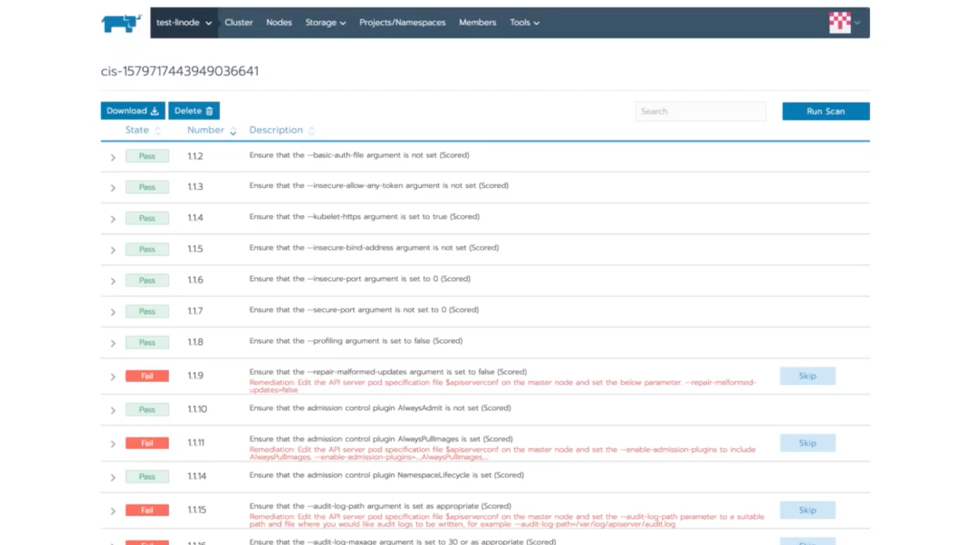
Finally, Rancher 2.4 adds CIS Scan, which allows users to run ad-hoc security scans of their RKE clusters against more than 100 benchmarks published by the Centre for Internet Security (CIS).
Rancher Labs now claims its distribution of Kubernetes can now support up to 2,000 clusters and 100,000 nodes. In a future release, Rancher will be able to support 1 million clusters, according to the company.
Liang says it is clear Kubernetes environments will be highly distributed. In addition to deploying instances of Kubernetes on-premises and in the cloud, organizations are now deploying Kubernetes clusters more widely on edge computing platforms.
Liang says that despite there being more than 100 certified distributions of Kubernetes, the primary competitors in the enterprise are Red Hat and VMware. If organizations opt to deploy Kubernetes on a single cloud they most likely will rely on a managed Kubernetes service provided by that cloud service provider. It’s only when Kubernetes is deployed either in an on-premises environment or across multiple cloud computing environments that a real opportunity appears for Rancher Labs and its primary rivals, he says.
Privately held, Rancher Labs is fresh off raising an additional $40 million in funding. The company claims in that 2019 the opportunities in on-premises or across multiple cloud computing environments have driven a 169% increase in revenue year over year.
The battle to control the operationalization of Kubernetes may have brewing for a long time, but it’s only just now beginning in earnest. It’s unclear what impact the downturn in the economy caused by the COVID-19 pandemic might have on the appetite for new IT platforms. However, the longer-term trend toward building microservices-based applications that will be deployed on Kubernetes clusters should continue. The challenge IT teams will face is determining what instance of a control plane platform makes the most sense for them.
In the meantime, it’s worth noting IT professionals that do have some level of Kubernetes expertise are likely to find their skills in higher demand than those that can only manage legacy platforms. At a time of great uncertainty, most organizations are going to be looking for IT professionals who can effectively manage as many IT platforms as possible.