Granulate Updates Open Source Kubernetes Profiling Tool

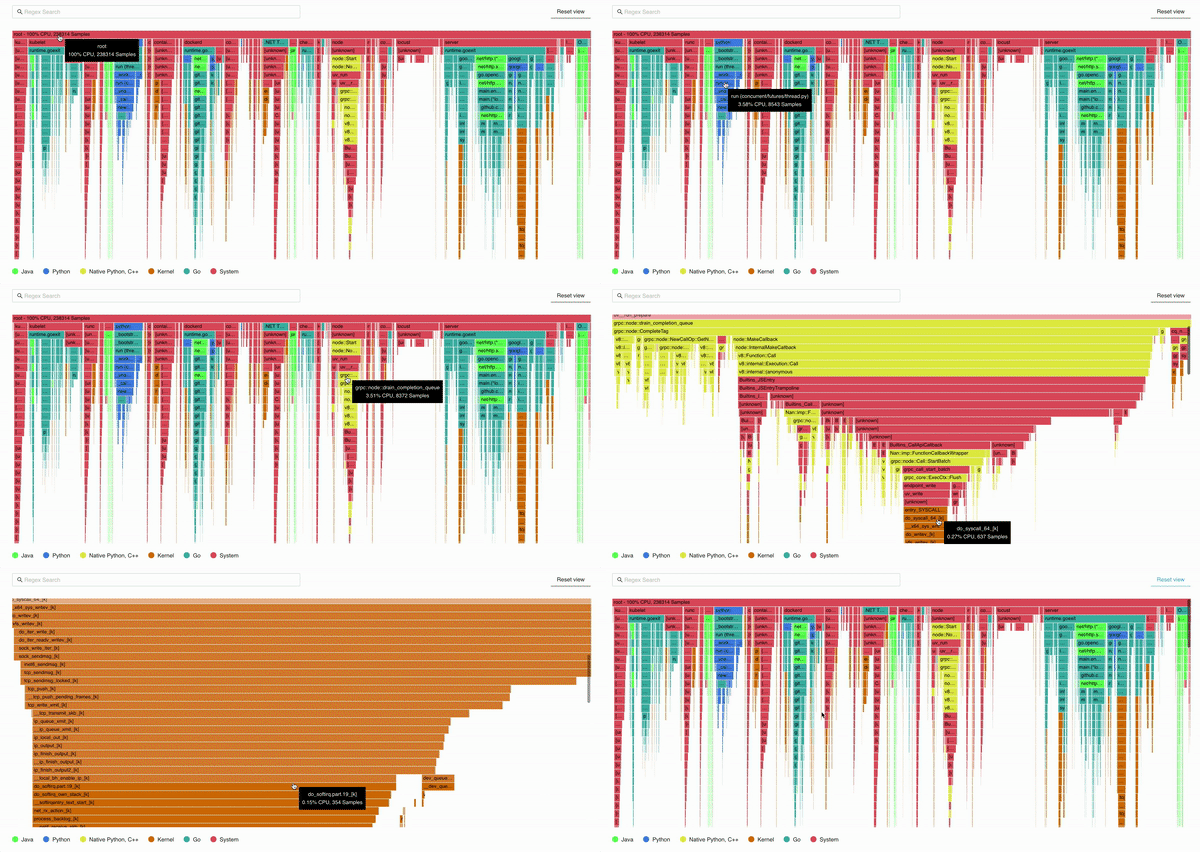
Granulate today released an update to its open source profiling tool that enables IT teams to investigate the behavior of multiple Kubernetes clusters across different regions and even code versions.
Asaf Ezra, Granulate CEO, says IT teams can now employ the free gProfiler tool to profile cluster behavior all the way down to the container name, hostname or Kubernetes deployment object level. Previously, the tool enabled IT teams to profile the hosts, nodes and pods to better determine which clusters might be overprovisioned or required applications to battle for limited infrastructure resources.

Overprovisioning of Kubernetes clusters is an issue despite the autoscaling capabilities of the platform, because many developers are simply used to provisioning the maximum amount of IT infrastructure whenever they deploy an application, notes Ezra. The issue that creates is that the cost of all the unused IT infrastructure starts to add up, he adds.
Granulate crated gProfiler as part of a suite of workload optimization and cost reduction tools it already provides for Linux servers. The latest release makes it possible to investigate the behavior of different deployments from within a single instance of the profiling tool, says Ezra. The Granulate tool is also simple to set up and requires no code changes to applications written in Java, Go, Python, Scala, Clojure, Kotlin, Node.js, Ruby and PHP.
In terms of overhead, Ezra also notes gProfiler creates less than a 1% utilization penalty when deployed in a production environment. The tool itself can be found on GitHub or via the free public image in AWS, Azure and GCP, or as a free container image in the Docker registry.
There is increased focus on cost control as organizations come to terms with managing IT in the COVID-19 era. Many organizations were anxious to deploy applications quickly at almost any cost during the early days of the pandemic. Now, however, many of those deployment decisions are being reviewed as part of an effort to regain control over costs. As the number of Kubernetes clusters deployed in production environments continues to expand, centralized IT operations teams are also now starting to apply more rigor to the management of Kubernetes clusters that, in many cases, were first provisioned by developers.
Regardless of how Kubernetes clusters are managed, there is a clear need for greater visibility across what has become a complex distributed computing environment. IT teams of all sizes are investing in a wider range of observability tools as part of an effort to better understand the interactions occurring across those environments. The expectation is that those tools will enable IT teams to identify and resolve issues before they become acute.
In the meantime, the number of Kubernetes clusters being deployed in production environments continues to grow. As that trend continues, the days when IT organizations could view Kubernetes as a DevOps project that rogue application development teams could manage on their own are now coming to an end.