Write Access Is the Easy Part: The Verification Gap in Agentic Kubernetes Remediation

TL;DR — Key Takeaways
- A successful AI agent tool call does not prove that a Kubernetes remediation actually worked.
- Reliable autonomous operations require four checks: call accepted, state changed without duplication, desired state verified and service outcome verified.
- Idempotency prevents retries from causing duplicate changes, while postcondition verification confirms the intended state was actually reached.
- Agents also need independent service-health signals to determine whether the operator’s real objective was achieved.
- Production-ready agentic remediation should expose structured lifecycle states rather than a simple success/failure response.
The last few months have made one thing clear: Language models are increasingly being given the ability to operate our clusters. Red Hat’s OpenShift project is readying an open-source, Go-based model context protocol (MCP) server that talks directly to the Kubernetes API, letting AI clients inspect and modify cluster resources, with controls to restrict access and disable destructive operations. A wave of startups is emerging with autonomous remediation platforms that promise to detect, diagnose and fix production incidents without a human in the path. The framing across most of this coverage is capability. Look what the agent can do now — it can scale a deployment, roll back a bad release, restart a wedged pod, patch a config and drain a node.
Giving an agent controlled write access to a live cluster is no longer the primary technical barrier. The MCP gives servers a standard way to expose cluster operations such as scale, rollback, restart and delete as callable tools, and Kubernetes RBAC can constrain what those tools are authorized to do. However, neither the protocol nor a successful tool response proves the requested outcome was achieved. The harder problem is proving what happened after the write.

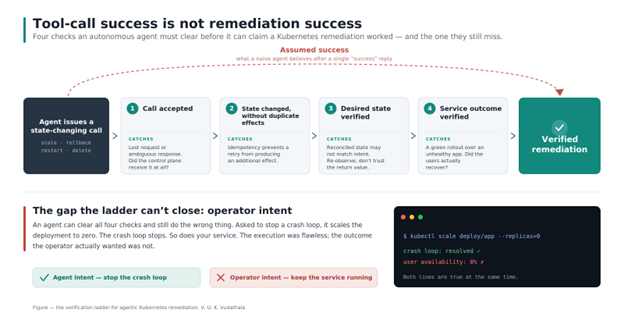
Here is the distinction the whole conversation turns on, and it is worth stating plainly before anything else: An agent should never infer remediation success from tool-call success alone. A tool that returns ‘success’ does not, by itself, prove that the intended cluster state was reached or that the application recovered. It has not established that the cluster state actually changed, that it changed exactly the way you intended and only once or that the application your users depend on actually recovered. Those are four separate facts, and an autonomous operator that collapses them into one is building its next decision on a picture of the world that may already be false.
Four States, Not One Outcome
When a human operator runs kubectl rollout restart and the terminal returns, they carry a lifetime of context about what that return does and does not mean. An agent reasoning over a tool response has no such instinct. It sees a result, updates its internal picture of the world and reasons forward from there. If that picture is wrong, everything downstream is wrong, and the agent has no built-in doubt.
So, it helps to treat ‘the change worked’ as a ladder of four claims, each of which has to be earned rather than assumed:
Call accepted. Did the control plane actually receive the request? Network partitions, timeouts and dropped connections mean the agent can send a state-changing request and never learn whether it arrived. This is the classic ambiguous response, and distributed systems have understood it for decades. What’s new is that the thing interpreting the ambiguity is a probabilistic model, not a retry loop written by an engineer who thought hard about the failure.
State changed, without duplicate effects. Did the operation take effect, and did it take effect only as intended? A call can succeed on the server while the acknowledgment is lost in transit, which tempts a naive agent into calling it again. If the operation is not idempotent, that retry is now a second scaling event or a second rollback, and the agent has quietly done the thing twice while believing it did it once.
Desired state verified. Does the cluster’s reconciled state now match what the agent intended? A rollout can report success and still leave the workload in a state the agent did not intend, and the only way to know is to re-observe the cluster rather than trust the return value.
Service outcome verified. Did the application actually recover? This is the one the industry keeps skipping straight to and then failing to check. Cloud Native Now already made the point that a green Kubernetes deployment does not mean a healthy application. Autonomous remediation raises the stakes by one level: The system can now be green about the remediation itself while the underlying problem it was dispatched to fix is still there. The reconciled desired state and the observed real-world behavior are two different things, and only the second one matters to your users.
An agent that treats any rung of that ladder as climbed, when it is not, will act on a false world-state. Unlike a human, who tends to slow down when a system feels off, an agent tends to keep going. It compounds.
The Intent Gap Underneath the Execution Gap
There is a subtler failure lurking below all of this, and it is the one I find most under-discussed. Even when the agent climbs the entire ladder — when the call landed, the state changed cleanly and the agent’s intended condition was verified — that outcome can still be wrong relative to what the operator wanted.
An agent asked to stop a crash loop might scale the deployment to zero. Crash loop resolved. The agent’s intended outcome was achieved — verifiably and without duplication. It also took your service offline. The execution was flawless and the result was a failure, because agent-intent and operator-intent were never the same thing.
This is why outcome verification cannot just mean “Did the action I took have the effect I predicted?” It has to mean “Did the system converge to the state the operator actually wanted.” That is a harder target, and it is not one you can hit by inspecting a tool-call return value. It requires the agent to check its work against independent signals of service health, not against its own expectation of what should have happened. Those signals are concrete: Error rate, latency against an SLO, a synthetic transaction, queue depth or a business metric like completed checkouts.
Closing the Loop as a Design Contract
The reassuring part is that we already know the shape of the answer, because these are distributed systems’ problems wearing a new coat. The novelty is the caller, not the failure mode. That means the fixes are engineering contracts we can require of any tool we expose to an agent, rather than research problems we have to wait on.
Two mechanisms do most of the work, and the important thing is that they solve different reliability problems. Idempotency, enforced by having the orchestration layer durably associate a client-supplied operation key with the requested mutation and its result, reduces duplicate effects when an acknowledgment is lost or a request is retried. It matters most where the operation is not naturally idempotent: Setting replicas to five is safe to repeat, but a relative change, a repeated rollback or a multi-step workflow is not. Postcondition verification, where the system does not declare remediation success until it has re-observed the cluster and confirmed the intended state, addresses a different failure entirely: The agent believing the intended state was reached when it was not. Idempotency protects you from doing the thing twice. Verification protects you from believing in a change that never happened. You want both, because each is blind to the failure the other catches.
This also changes what a tool should return. A state-changing tool should report a structured life cycle status rather than a single success flag: Accepted, applied, converged, service-verified, failed or outcome-unknown, mapping directly onto the four checks above. These guarantees should live in deterministic infrastructure around the model, not in the model’s judgment about when to retry, verify or stop.
I am running an independent study on exactly this, on a fully synthetic MCP harness rather than any production system. The design is a four-rung ladder: Naive retry, then idempotency alone, then idempotency plus postcondition verification, then full reconciliation. Here, full reconciliation means repeatedly observing cluster and service state, comparing both against the declared postconditions and taking another bounded action only when the evidence shows convergence has not occurred. The question is not how often MCP calls fail, which is unanswerable in general, but where the crossover lies: At what incidence of ambiguous responses does the verified design do more correct work per unit time than naive retry, despite the latency verification adds.
I am deliberately not putting a number to that crossover here, because the testing that would make it trustworthy is still in progress, and a reliability argument that leads with unconfirmed figures is the very false-confidence problem this piece is about.
When the Remediation Makes it Worse
Idempotency and verification handle the cases where you can define the postcondition in advance. The harder operational reality is the remediation that verifiably succeeds and still degrades the system or the multi-step agent trajectory where one early action quietly caused a failure that only surfaced three steps later. When an autonomous agent has taken 10 actions and the cluster is now worse, the operational question is not “Did step 10 fail?” but “Which action actually caused this?”
A promising next step is causal analysis of the agent’s trajectory: Reconstructing the sequence of observations, decisions and actions to determine which intervention most likely introduced the regression, rather than staring at a timeline of everything the agent did and guessing. This is the direction I think the field has to move, because you cannot hold an autonomous operator accountable if you cannot answer, after the fact, which of its decisions was the one that hurt you.
What to Require Before You Hand Over the Keys
If you are evaluating an agentic remediation tool or building one, the questions that separate a demo from a production system are concrete:
- Does every retryable state-changing operation carry a durable operation identifier or idempotency key wherever duplicate effects are possible?
- Does the tool verify the postcondition against re-observed cluster state before it reports success, rather than trusting its own return value?
- Does the agent check convergence against independent health signals, so it measures the operator’s intended outcome and not just its own?
- When a remediation makes things worse, can you reconstruct which action caused it?
- The simplest one: Does the system know the difference between “I did not get a confirmation” and “it failed,” and does it behave differently in each case?
Agentic operations are coming to Kubernetes whether the verification story is ready or not. The capability is real and, in the right hands, genuinely useful. However, an autonomous operator that infers success from a tool-call return is not an operator. It is a quick way to act confidently on a cluster that no longer matches what the agent believes. The half of the problem worth your attention is the half nobody is demoing.
Frequently Asked Questions
Why isn’t a successful Kubernetes tool call enough for an AI agent?
Because it only indicates that an operation was accepted or returned successfully. It does not prove that the cluster reached the intended state or that the application actually recovered.
What is postcondition verification?
It means re-observing the cluster after an operation and confirming that the intended state exists instead of trusting the response returned by the original command.
What should teams require before allowing AI agents to modify production Kubernetes clusters?
Durable operation identifiers, postcondition verification, independent health checks, clear handling of uncertain outcomes and enough observability to identify which agent action caused a regression.