
Shattering the Kubernetes Registry Bottleneck: Scaling Enterprise CI/CD With P2P Mesh Architecture

If you have ever scaled a Kubernetes deployment across hundreds of nodes during a high-traffic event, you have likely encountered the silent killer of deployment velocity: The ‘thundering herd’ problem.
In standard cloud-native environments, container orchestration is flawlessly decentralized, yet our artifact distribution remains painfully centralized. When a massive scale-out event triggers, hundreds of nodes simultaneously hit the exact same central Open Container Initiative (OCI) registry — whether it’s Harbor, AWS ECR or JFrog — to pull the exact same multi-gigabyte image.

The result? Saturated network ingress, throttled registry APIs, dreaded ImagePullBackOff errors and a complete degradation of your mean time to recovery (MTTR).
To solve this, platform engineering teams are abandoning centralized pulls and shifting to peer-to-peer (P2P) distribution. At the forefront of this architectural shift is ‘Dragonfly’, a CNCF graduated project that transforms standard Kubernetes clusters into self-healing, high-speed P2P distribution meshes.
The Anatomy of the Thundering Herd
Traditional CI/CD pipelines treat image distribution linearly. The CI runner builds the image, pushes it to a central registry and the CD controller (such as ArgoCD or Flux) tells the cluster to deploy it.
This works perfectly for small clusters. But consider an AI/ML workload or a Java Spring Boot microservice scaling from 10 to 200 replicas in response to traffic. If the container image is 2 GB, the central registry is suddenly hit with a request to serve 400 GB of identical data across 190 distinct network connections.
Scaling the central registry (adding more replicas or heavier load balancers) only masks the symptom; it doesn’t cure the underlying architectural flaw. The network switch itself becomes the bottleneck.
Enter Dragonfly: Native P2P for Kubernetes
Dragonfly fundamentally rewrites the distribution topology. Instead of 200 nodes asking a central server for the same file, one node pulls the file, and then the nodes share it directly with each other over the local network switch.
Dragonfly’s architecture is built on three core components:
- The Manager: The control plane that maintains the P2P network topology and dynamically calculates the most efficient routing paths between nodes.
- The Seed Peer (Supernode): A highly available cache that pulls the original artifact from the central registry and seeds it into the local P2P mesh.
- The Dfdaemon (Peer): A lightweight proxy deployed as a Kubernetes DaemonSet on every worker node. It intercepts standard container runtime (containerd/CRI-O) pull requests and diverts them into the P2P network.
How the Interception Works (Under the Hood)
The brilliance of Dragonfly is that it is completely transparent to the end user and the container runtime. Developers do not need to rewrite their Kubernetes manifests or change their image tags.
When a pod is scheduled, containerd attempts to pull the image. The Dragonfly dfdaemon running on that node intercepts the HTTP/HTTPS request.
- Cache Miss: If the file block is not in the P2P mesh, the Dfdaemon requests it from the Seed Peer. The Seed Peer pulls it from the central registry (e.g., AWS ECR) exactly once.
- Block Seeding: As the Seed Peer downloads the image, it streams the data in small, distinct blocks.
- P2P Swarming: Once Node A has Block 1, Node B can pull Block 1 directly from Node A, while Node A pulls Block 2 from the Seed Peer.
Within seconds, the entire cluster is acting as a massive, localized CDN. The load on the central registry drops by up to 99%, and deployment speeds increase exponentially as the cluster size grows.
Implementation: Wiring Dragonfly to Containerd
Deploying Dragonfly into a production Kubernetes cluster is remarkably straightforward via its official Helm chart. However, the critical integration point is configuring your container runtime to respect the proxy.
For containerd, this involves updating the registry mirror configurations in /etc/containerd/config.toml to route traffic through the local dfdaemon (which typically listens on 127.0.0.1:65001).


Once this configuration is applied and the containerd service is restarted, all future kubectl apply commands will automatically leverage the P2P mesh without any developer friction.
Beyond Containers: The AI/ML Frontier
While solving the container registry bottleneck is a massive victory for standard DevOps, Dragonfly’s architecture is currently solving an even larger crisis in the AI infrastructure space: Distributing massive large language models (LLMs).
When deploying models such as Llama-3 or DeepSeek via platforms like vLLM, the bottleneck is no longer a 2 GB container; it is a 130 GB tensor weight file. Pulling a 130 GB file across 50 GPU nodes simultaneously will instantly crash standard network gateways.
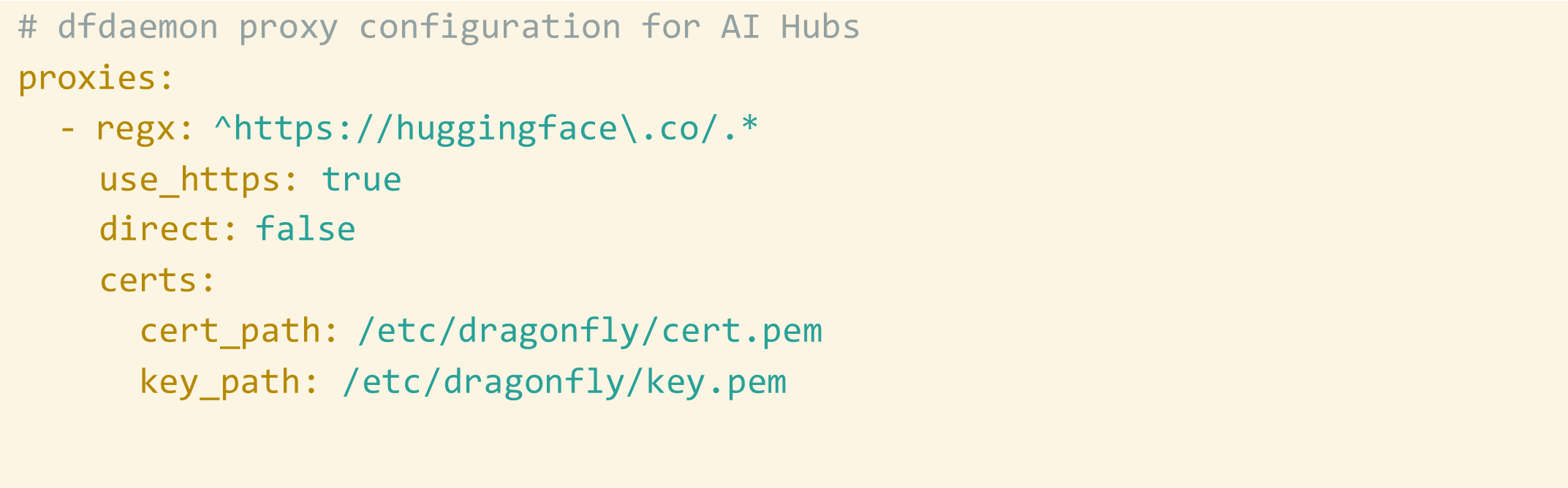
To address this, the Dragonfly community recently expanded the platform’s capabilities to natively support AI model hubs. By configuring the dfdaemon proxy rules, infrastructure teams can intercept traffic targeting hf:// (Hugging Face) and modelscope:// protocols.
This evolution turns Dragonfly from a simple container accelerator into a critical piece of enterprise AI infrastructure, allowing GPU clusters to share massive tensor weights P2P over high-speed local NVLink or InfiniBand networks.
The Verdict for Platform Teams
The transition from centralized infrastructure to decentralized topologies is inevitable as compute scales. Relying on a single registry to serve thousands of ephemeral containers is an architectural anti-pattern.
By integrating CNCF Dragonfly into your CI/CD and deployment workflows, you eliminate network single points of failure, drastically reduce cloud egress costs and ensure that your infrastructure actually gets faster — not slower — as your cluster grows.
The next time your autoscaler triggers a massive scale-out, your network switch will thank you.
