Red Hat Makes Available Supported Version of Podman Desktop Tool for Containers

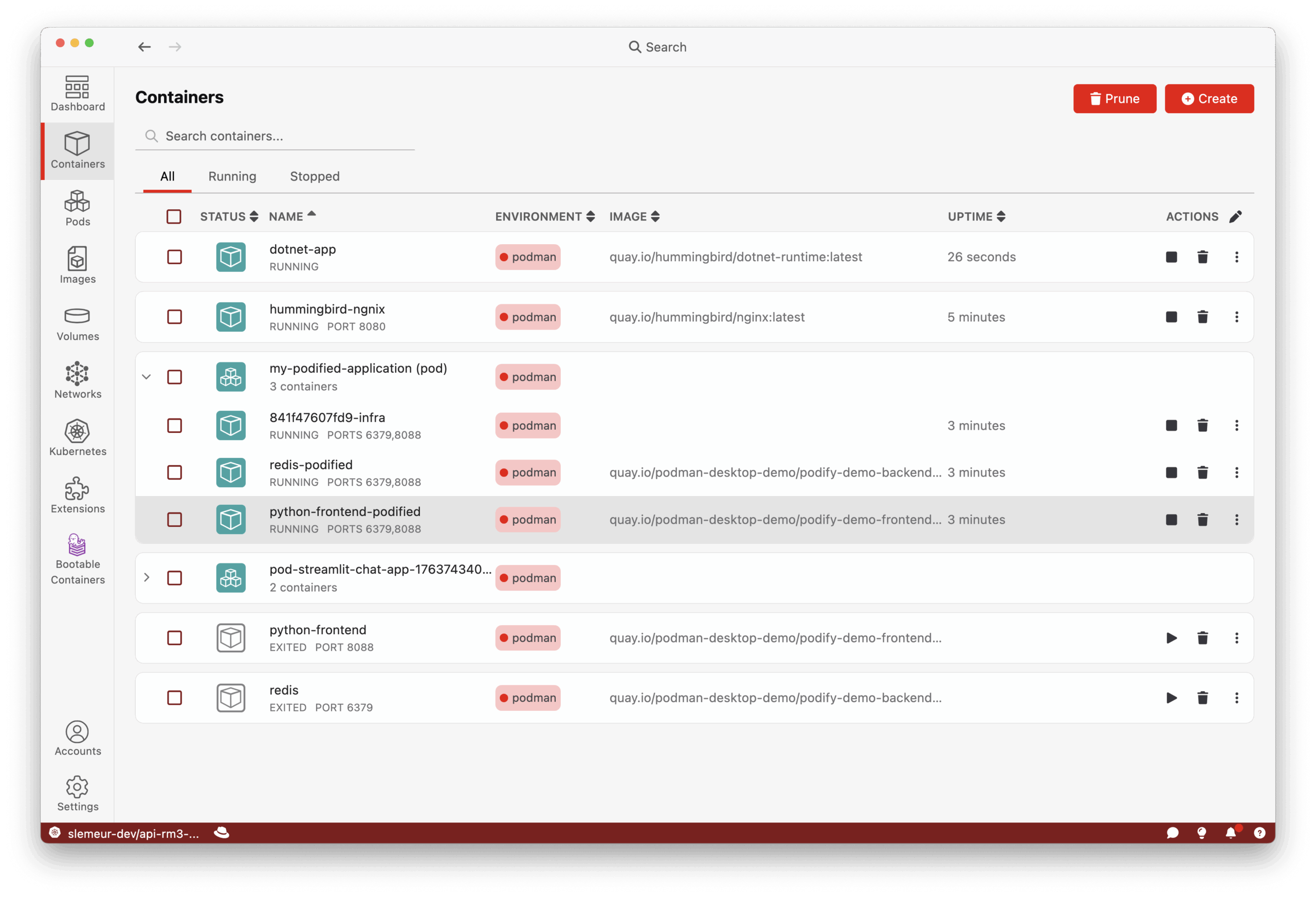
Red Hat this week made available an enterprise-supported version of the open source Podman tool it created for developing, managing and running containers.
James Labocki, senior director of product management for Red Hat, said the Red Hat build of Podman Desktop is being made available in response to requests from customers that, for one reason or another, are not allowed to deploy open source software that is not supported by an IT vendor.

Previously, Red Hat donated both Podman and Podman Desktop to the Cloud Native Computing Foundation (CNCF), which natively support Kubernetes clusters in a way that reduces friction between developers building applications on their local machines and Kubernetes clusters running in a production environment. Podman has now already been downloaded more than three million times mainly because of its inherent ability to bridge that divide in a way that also makes it simpler to track the provenance of containers, he added.
In general, application development teams are only as fast as their slowest process, so narrowing the divide between developers and production environments is crucial for any organization trying to accelerate the pace of software development, noted Labocki. Arguably, one of the primary reasons so many IT teams are embracing platform engineering as a methodology for building and deploying cloud-native applications at scale is to achieve that goal, he added.
Additionally, a recent CNCF survey finds 82% of enterprise IT teams are now running Kubernetes clusters in production environments, with a quarter (25%) employing cloud-native technologies across all their application development and deployment workflows.
Similarly, a Futurum Group survey finds two-thirds (66%) of respondents work for organizations relying on Kubernetes for internal business software, compared to 48% that have deployed customer-facing applications.
Mitch Ashley, vice president and practice lead for software lifecycle engineering at the Futurum Group, said Red Hat’s decision to offer enterprise support for Podman Desktop marks another point where container-based development workflows have crossed from early adopter territory into workflows that are being used to build and deploy enterprise-class applications. That level of support removes the procurement blocker that has kept regulated industries and risk-averse IT shops on the sidelines, he added.
The challenge is that as teams standardize on developer platforms that enforce consistent tooling and workflow policies, open source software can create audit and liability exposure that enterprise license coverage resolves, noted Ashley.
It’s not clear what percentage of applications being built and deployed in the enterprise are now running on Kubernetes clusters, but with each passing day the number steadily increases. Each organization will need to determine for itself at what rate to not only build new cloud-native applications but also refactor or retire legacy monolithic applications. The one thing that is certain is that Kubernetes has finally emerged as a de facto standard for building and deploying modern applications. The challenge now is making it as simple as possible for developers to build those applications on a platform that, while powerful, is still challenging for many of them to master.