Graphical Tool for Deploying Kubernetes Gets Certified

One of the first graphical tools to ever be created to simplify deploying Kubernetes has been certified as a Kubernetes installer by the Cloud Native Computing Foundation (CNCF).
Dubbed Breeze, the open source tool created by Wise2C Technology leverages playbooks based on the Ansible IT automation framework and are designed to make it easier for the average IT administrator to configure a Kubernetes cluster.

Alex Zhu, business director for Wise2C Technology, says Breeze also can be used to enable deployment of Etcd, Harbor and Prometheus, Istio and a range of other open source projects that are gaining traction among the Kubernetes community. Breeze also functions as a local YUM Repository server. All Docker images will be pulled from the local Harbor registry.
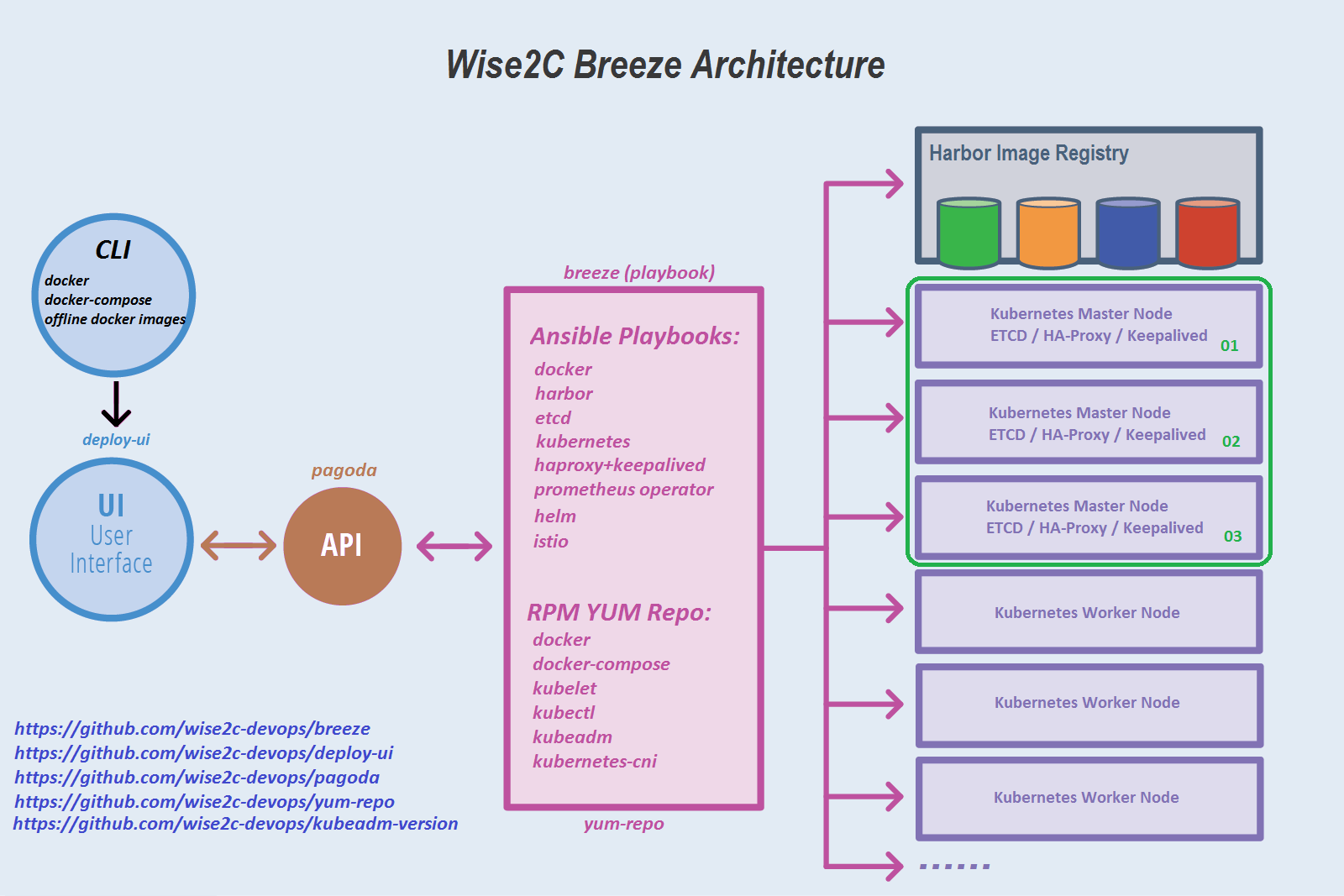
Breeze also can support multiple Kubernetes clusters deployments, in addition to a high-availability configuration involving three master servers and worker nodes that share the same floating IP address.
Finally, after four core images have been loaded, Breeze can set up a Kubernetes cluster without requiring access to the internet, Zhu says, which is critical in some highly regulated environments where Kubernetes clusters need to be able to run offline.
The availability of graphical tools to configure Kubernetes clusters should go a long way toward bridging a divide that has conspired to limit adoption of the technology. While it has become more accessible in recent years, it still reflects its heritage as a platform built for engineers by engineers. However, the average IT organization relies on IT administrators who are more comfortable relying on graphical tools that automate many lower-level commands and processes. Those IT administrators are playing a much bigger role in driving Kubernetes adoption. A survey of 500 IT leaders published by Diamanti, a provider of hyper-converged infrastructure (HCI) platform for containerized applications, finds 35% of respondents said IT operations teams are now driving container adoption—an 18% increase from a similar survey Diamanti published a year ago. That compares to platform architects (22%), developers (16%) and integrated DevOps teams (9%) who the survey identified as the primary driver of container adoption.
Of course, in some cases developers are taking it upon themselves to configure Kubernetes clusters programmatically. There are many IT organizations that are still not comfortable with that idea, largely because of the workflow process they have set up around IT operations teams. A graphical tool for configuring Kubernetes will make it easier for those organizations to embrace Kubernetes without having to re-engineer those processes.
In the meantime, a recent separate survey of 500 attendees of the recent Kubecon + CloudNative Europe conference conducted by Platfrom9, a managed service provider (MSP), found operational complexity to be the top challenge (50%) organizations now face when trying to deploy Kubernetes in a production environment. No matter how powerful a platform Kubernetes is, mass adoption of Kubernetes in the enterprise is not likely to be ever achieved until it becomes easy for every type of IT professional to deploy, regardless of skill level.