
Kubernetes Release Cycles and Vendor Support Harbor Freedoms–and Sacrifices

Kubernetes is the de facto standard for container orchestration, but it’s never standing still. The open source community and vendors that back Kubernetes (K8s) are continually innovating, creating new opportunities for modernization, choice, and flexibility across industries and businesses. Keeping pace with K8s innovations and incorporating them into your container environment requires more than just technical expertise; you also need a clear understanding of release timelines, support commitments from vendors, and the costs associated with support.
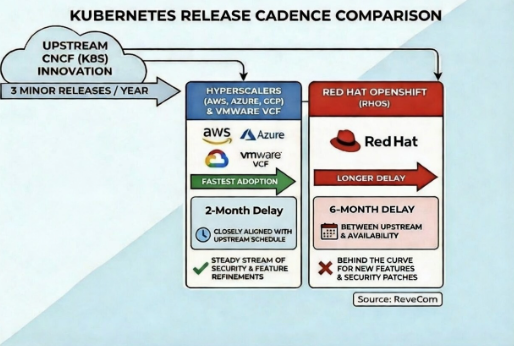

To that end, a new ReveCom analysis explores the implications of what it calls the “lag gap”: The two- to seven-month delay between when the Cloud Native Computing Foundation (CNCF) releases Kubernetes updates and they are Generally Available (GA) through Kubernetes platforms offered by on-premises cloud infrastructure providers or hyperscalers.
“The comparative data offers a coherent picture for those concerned about how and when Kubernetes updates and support become available,” Bruce Gain, co-founder and chief analyst at ReveCom, said. “The importance of long-term stability and, of course, the cost factors associated with the different options are key considerations.”
The CNCF maintains the K8s open source project and defines conformance standards, thereby playing a crucial role in the Kubernetes ecosystem’s modernization. CNCF averages three minor Kubernetes version releases per year. Once a stable, generally available (GA) version of Kubernetes is released under the CNCF’s stewardship, enterprise organizations can reasonably expect access to it for 14 months before it officially reaches end of life (EOL) by CNCF. This consists of 12 months of active support as well as an informal two-month grace period for upgrades.
This 14-month window is critical because it represents the period during which CNCF support, patches, security updates, and feature enhancements for each specific K8s minor version. Enterprises use this timeframe to plan their infrastructure upgrades, manage risk, and ensure compliance.
Release Dates and Cadence
An enterprise’s ability to leverage innovation is directly tied to whether its vendor’s supported version includes the latest stable features and security fixes available in the CNCF’s upstream K8s. This makes it crucial to understand the pros and cons of a vendor’s K8s release cadence.
Hyperscalers AWS, Azure, and GCP release K8s and Broadcom’s VMware Cloud Foundation (VCF) within two months of the upstream release, faster than platform provider Red Hat. Broadcom’s VMware Cloud Foundation (VCF) releases within two months, making its release cycles competitive with the hyperscalers and closely follows the release cycle of Kubernetes project’s upstream-release average of three minor version releases each year.
The Red Hat OpenShift (RHOS) K8s platform can come with a six-month delay between the upstream Kubernetes release and the next version’s availability. It means RHOS customers can be behind the curve for new K8s features. The difference in release cycles presents a fundamental strategic choice for enterprises.
Red Hat OpenShift’s underlying architecture requires custom vertical integration with the underlying Red Hat operating system and stack. Therefore, as a deeply custom-integrated platform model, RHOS must undergo a comprehensive integration, testing, and validation cycle as part of a platform-integrated lifecycle approach before Red Hat certifies a new upstream Kubernetes version.
In an enterprise context, this lag represents a strategic choice between immediate feature adoption and a more conservative update path. The consequence is that RHOS customers often do not have access to upstream innovations for six months after a new Kubernetes version is GA. This applies to upstream feature innovation, newly introduced Kubernetes APIs and security enhancements, and enhancements that closely mirror upstream Kubernetes releases.
Support Durations and Life Cycle Costs
Aside from differing release cadences, different K8s vendors have different standard support timelines for releases. The CNCF benchmark is 14 months, VMware VCF offers a longest 24-month standard support window, and RHOS provides full standard support for six months only and maintenance releases for 12 months after the GA release. The hyperscalers’ standard support windows vary: 12 months for Azure Kubernetes Service (for most versions), 14 months for Amazon EKS, and 14 months for Google Kubernetes Engine (GKE).
The support window is significant for stability; a longer period of standard support gives enterprises access to new features without incurring any incremental cost. An extended support window also provides greater stability for the production environment. This gives organizations more time to plan, test, and execute upgrades when newer versions become available or are necessary for compliance and/or security requirements.
Enterprises must also consider the cost of Kubernetes support beyond the standard period. Many organizations turn to hyperscaler providers (AWS, Azure, GCP) for Kubernetes. Hyperscaler Extended Support Fees can total over $5,000 per cluster, per year. These are substantial recurring costs, and when multiplied across numerous clusters in a large enterprise, these fees can represent a significant portion of the total cost of ownership (TCO).
VMware VCF offers the longest standard support period (24 months) with no incremental cost. This is a powerful differentiator, as it enables enterprises to leverage the latest Kubernetes versions for an extended period without worrying about expiring support, purchasing expensive premium add-ons, or moving to a different vendor’s managed service for continued support.
Additionally, running these workloads on virtualized infrastructure significantly improves the upgrade experience compared to bare metal. Organizations benefit from enhanced operational flexibility, such as the ability to snapshot nodes for instant rollback and more seamless workload migration, allowing them to better align with enterprise change management processes while reducing the risks of forced upgrade cycles.
The Red Hat OpenShift lifecycle includes a base of 18 months of support (6 months of full support plus 12 months of maintenance support). For even-numbered releases only, this can be extended to a total of 36 months through optional EUS add-on terms (a six-month Term 1 plus a 12-month Term 2) that are not automatically included in all subscriptions and must be purchased as add-ons for Standard SLA customers. While some organizations may prefer to opt for older even versions of Kubernetes in consideration of longer support windows, they forgo the newer node configuration and features that come with the odd-number releases, which are strictly restricted to the 18-month support ceiling. Some organizations would likely prefer the freedom to adopt odd-number Kubernetes releases with extended support—as 36 months of “full” support is not a phase provided under any Red Hat policy—instead of having to wait to adopt the next even-number release for the longer support window.
These lifecycle differences that organizations adopt reflect more than timing differences, where platforms either prioritize rapid upstream feature parity or emphasize a deeply integrated platform model for enterprise-grade stability. This strategic tradeoff is especially critical for regulatory compliance in government contracting, where mandates like the U.S. FIPS 140-3, FedRAMP, and DISA STIG adherence favor stable, certified lifecycles. When specific compliance must be adhered to in order to meet the terms of government contracts, integrated models ensure that an organization’s Authority to Operate (ATO) and security posture are prioritized over the immediate adoption of the latest upstream features.
The Enterprise Path
Navigating Kubernetes in an enterprise setting is more than just having the technical know-how to deploy and manage clusters. Ultimately, a Kubernetes lifecycle strategy is a broader platform architecture decision affecting innovation velocity, compliance posture, upgrade complexity, and long-term TCO. Organizations must understand the nuances of support duration, release cycles, and associated costs. Hyperscalers provide managed Kubernetes with potentially fast updates, but at a much higher recurring cost for extended support beyond the standard period. VMware VCF is a strong contender for organizations that require rapid innovation and long-term standard support without recurring premium costs. Red Hat OpenShift offers enterprise support; the trade-off is a six-month delay in access to new Kubernetes features. Armed with an understanding of K8s release cycles and how they affect support and costs, enterprises can make more informed decisions aligned with their specific priorities relating to speed of innovation, long-term stability, and cost optimization.
